from data to action: how smaller wire & cable manufacturers can close the automation gap
(an article originally published in the May / June 2026 issue of Wire & Cable Technology International)
introduction
Wire and cable manufacturing has always required diligent control of the accuracy, efficiency, and flexibility of production. Each order is made up of a different combination of wire, connectors, terminals, routing configurations, and may also require unique testing requirements to satisfy customer needs. All production teams work their way around the entire shop floor, cutting, crimping, assembling, and testing all while managing constant schedule adjustments and customer demands. In many small and mid-size operations, this complexity is coordinated through a spread of operator knowledge, disconnected systems, spreadsheets, printed work orders, and manual reporting.

Over time, these methods have allowed manufacturers to operate successfully. Skilled technicians know how jobs are coming along and supervisors have a good feel for the pressure placed on each work center. Production continues moving forward. Yet, as demands increase and production environments become more dynamic, the limitations of current systems become more obvious.
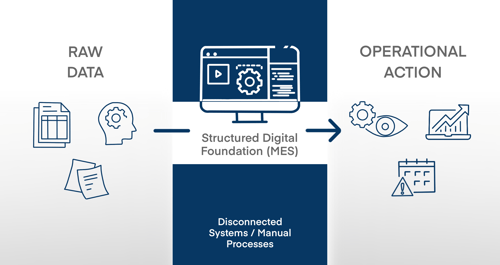
For many manufacturers, the problem is not with the amount of information they have available; there is a great deal of production data generated from inspection records, travelers, and operator logs. The real difficulty lies in how to utilize the information by bringing it together and making proactive production decisions based on it. When data is delayed, fragmented, or manually compiled, it’s easier to often rely on assumptions than real-time insight. As a result, the gap between available data and actionable insight continues to widen. Closing this gap is quickly becoming one of the most essential priorities for manufacturers looking to maintain stability in an increasingly uncertain environment.
why smaller manufacturers approach automation differently
Automation is a trending topic in manufacturing today, but the path towards it is not without its challenges, especially for smaller manufacturers. While larger manufacturers frequently pursue high scale technology initiatives, small and mid-size wire and cable manufacturers approach automation through a more practical and incremental view.
Large manufacturers typically have dedicated “digital transformation” teams, internal IT teams, and heavy budgets set aside for automation and future-forward initiatives. Projects may span multiple facilities and involve extensive integration between their enterprise systems, robotics, and advanced analytics platforms. This creates lengthy years-long implementation timelines, supported by specialized personnel to ensure the deployment.
On the other side, smaller manufacturers operate within a very different environment. Their production teams tend to be lean and the people operationally accountable for the business are the same ones responsible for driving continuous improvement within the organization. Plant managers, engineers, and supervisors must balance long term goals against immediate needs of customer demands, labor availability, and equipment uptime.
The nature of wire and cable further emphasizes this fact. Many smaller facilities are in a high mix environment where their product configurations can change frequently, and production runs can be short. There is a large reliance upon properly trained operators to complete assembly work and any automation initiatives must support these workflows rather than disrupt them. For these manufacturers, the question is rarely whether automation will eventually play a role. Instead, the focus is on how to affordably utilize those new technologies to deliver immediate value, strengthening the flexibility that smaller operations depend on each day.
common barriers to automation adoption
Despite growing awareness of digital manufacturing technologies, many small and mid-size manufacturers hesitate to pursue automation initiations. In many cases, these manufacturers aren’t necessarily unable to innovate, but have practical concerns shaped by the reality of their daily production.
One of the most frequent concerns is disruption of operations. Production schedules are strictly adhered to, and any disruption can create a ripple effect that causes delays down the line. Implementing new systems, even if essential, can appear too risky if working at the limit of your capacity. Manufacturers also become uncertain whether the amount of improved productivity they achieve through a new solution will offset the time required to implement and then learn how to utilize it.
Another barrier is the perception that manufacturing execution systems (MES) and other digital tools only apply to larger manufacturers. This results in many smaller manufacturers equating advanced technologies with long implementation cycles, integration problems, and significant overall investment. Many assume that the scale of these platforms exceeds the needs of their operations, though that is not the case in today’s environment.
Data fragmentation also plays a significant role. In some facilities, production information exists across multiple disjointed sources. Job performance may be tracked at individual stations, quality records documented on paper or spreadsheets, and scheduling updates communicated verbally on the floor. While each system functions independently, the lack of connection between them makes it difficult to develop a clear picture of real-time status. Over time, many companies create their own internal systems to try and fill these gaps. These DIY systems often begin as face-saving solutions to address quick issues, and although they may accomplish this in early stages, they prove to be less robust as operations mature and/or scale/flex. What might have started as a temporary bandage can ultimately result in an uncomfortable, inflexible, outdated, and unscalable system for the organization.

building a scalable, operator-centric environment
For many wire and cable companies, the path toward automation does not begin with advanced robotics or AI-fueled production lines, it begins with creating a structured environment where operators, machines, and production data are connected in ways that support daily decision making.
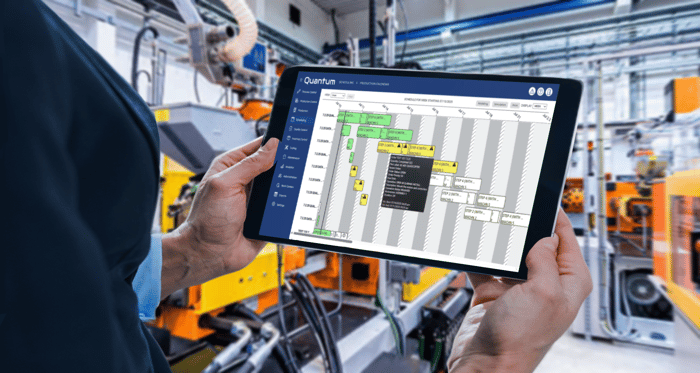
The first step is establishing consistent visibility into shop floor activity. Manufacturers have access to large volumes of data, yet much of it remains buried in paper records, your team, or compiled reports. Without a clear, reliable view, it can take managers multiple hours trying to determine which work orders are in progress, what’s causing a bottleneck, etc. Real-time visibility provides a foundation for more informed decision-making by allowing management to see the state of the entire floor. It is equally important to connect information directly to the work being performed on the floor.
Operators need to have accurate instructions, job priorities, and quality standards to execute correct builds. Digital systems that present the right information at the point of work can help ensure operators have immediate access to the instructions and data needed to perform their tasks efficiently.
As production data becomes more centralized, organizations gain the ability to standardize processes across the operation. Standardization improves scheduling reliability and enhances quality control, enabling companies to identify trends, measure their ability to meet expectations, and react quickly to new challenges. Once this foundation is established, automation can evolve gradually, side-by-side with the manufacturer. Digital work instructions, automated quality alerts, and predictive scheduling can be introduced in a way that feels like a natural extension rather than a disruptive change.
where the industry is heading
The manufacturing industry is entering a period of transition. Over the next several years, manufacturers are likely to face a combination of rising expectations, evolving supply networks, and continued pressure to do more with less. While many of these changes are gradual, together they will reshape how manufacturers act.
One of the most apparent changes has been the labor market factors. Skilled technicians continue to play an important role within the wire and cable sectors, yet experienced workers can be difficult to replace as companies grow and workforce demographics change. Many are placing greater emphasis on systems that can standardize processes, collect best-practices, and support training for new employees entering the shop floor.
Simultaneously, manufacturers are experiencing continual fluctuations in their production environments: demand, cash flow, material availability, and scheduling priorities. The ability to quickly adapt to these changes while keeping control over their operations will be the competitive difference many manufacturers seek. In this context, a growing divide is developing between companies that have structured digital systems and those that rely on manual methods. The difference comes down to operational control and the ability to translate data into timely decisions.
why MES is foundation for future operations
As the industry environment becomes more complex, many companies are recognizing the need for systems that connect activity across the shop floor. Manufacturing execution systems (MES) have become the operational layer that brings together machines, operators, and planning tools into a unified structure. At its core, an MES provides a consistent framework for collecting and organizing information in real time, allowing manufacturers to track work orders, production progress, quality checks, and more in a single location. This approach allows supervisors and managers to see the status of operations as they unfold rather than reconstructing events after production has already taken place.
For smaller manufacturers, the value of MES lies in its ability to provide structure without sacrificing flexibility. Rather than implementing a large and rigid system all at once, modern MES platforms exist crafted specifically for small and mid-size manufacturers that allow them to begin with foundational capabilities such as production tracking. As the organization becomes more comfortable with the system, additional capabilities can be layered over time. In this way, MES becomes less of a single technology investment and more of an operational foundation that supports improvement as manufacturing environments evolve.
conclusion
Wire and cable manufacturers have operated in environments that demand precision, adaptability, and speed. As product complexity increases and customer expectations evolve, the ability to manage production with consistency and control is becoming even more valuable. While most manufacturers already generate large amounts of data, the real opportunity lies in transforming that information into action. But building this capability does not require an immediate leap into large scale automation efforts. Instead, it begins with creating a structured foundation that connects across the shop floor. With clear visibility into their operations, manufacturers are better equipped to respond, maintain, and plan.
For many small and mid-size manufacturers, systems such as Quantum MES provide an attainable starting point. By supporting operators and organizing data in real-time, these platforms help bridge the gap between information and decision, allowing manufacturers to scale their digital capabilities where and when it makes sense for them.
read more of our wiring & cable manufacturing content
the overlooked opportunity: automating inventory for smaller manufacturers
“We’re too small for automation.” It’s a phrase you’ve probably heard, or maybe even said yourself. It’s a common belief. Automation sounds like a huge investment, something you’d expect in a massive plant producing thousands of identical harnesses every week. Not in a smaller shop running custom jobs or shorter batches.
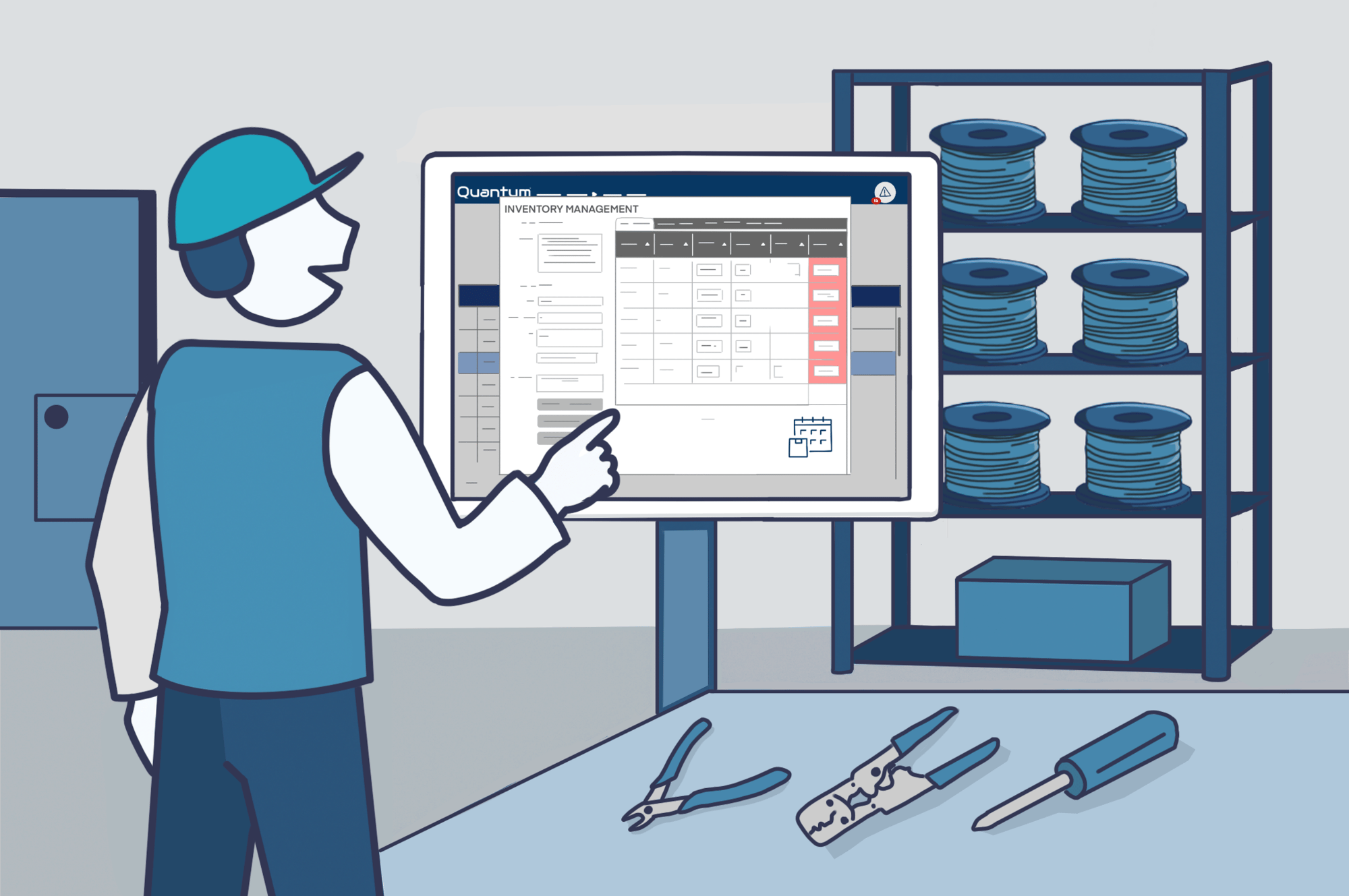
But here’s the thing: no manufacturer is too small to benefit from automation. In fact, day-to-day struggles of smaller operations (keeping track of materials, tools, and calibration dates) is often where the most time and money gets lost, and where automation can have the biggest impact. (an article originally published in the Sept/Oct 2025 issue of Wiring Harness News).
read more
control vs flexibility in wire harness production
The adage “best laid plans often go awry” holds particular significance in the complex and dynamic world of wire harness manufacturing. Unforeseen challenges, evolving customer demands, and the intricacies of the production process require a delicate balance between control and flexibility. On the one hand, adhering to strict specifications is absolutely critical. On the other hand, the very nature of manufacturing demands the ability to evolve and adapt. So how do we reconcile these seemingly opposing forces? How do we maintain the control for quality while embracing the flexibility that today’s wire harness manufacturing demands? (an article originally published in the March 2025 issue of Wiring Harness News)
read more
hear from CIMx at EWPTE
CIMx demonstrates their Quantum manufacturing execution system tool for harness manufacturers
.png?width=400&height=133&name=Untitled_Artwork%20(3).png)
let's untangle your processes
You compete in the most rigorous field of compliance. On paper, this is next to impossible. Many manufacturers turn to Microsoft for help. Access databases are not controlled and will not give you the compliance you require. Quantum gives you everything you need to get your job done on-time and compliant to the most rigorous standards of industry. And complete production control for production operations in wire and rope harness.